In the rapidly evolving landscape of North American finance, stability is no longer the only metric of success. Today, agility is the currency of survival. For decades, Canadian financial institutions—from the "Big Five" banks to local credit unions—operated on rigid, hierarchical structures. Hiring was a slow, deliberate process designed for lifetime employment. However, the rise …

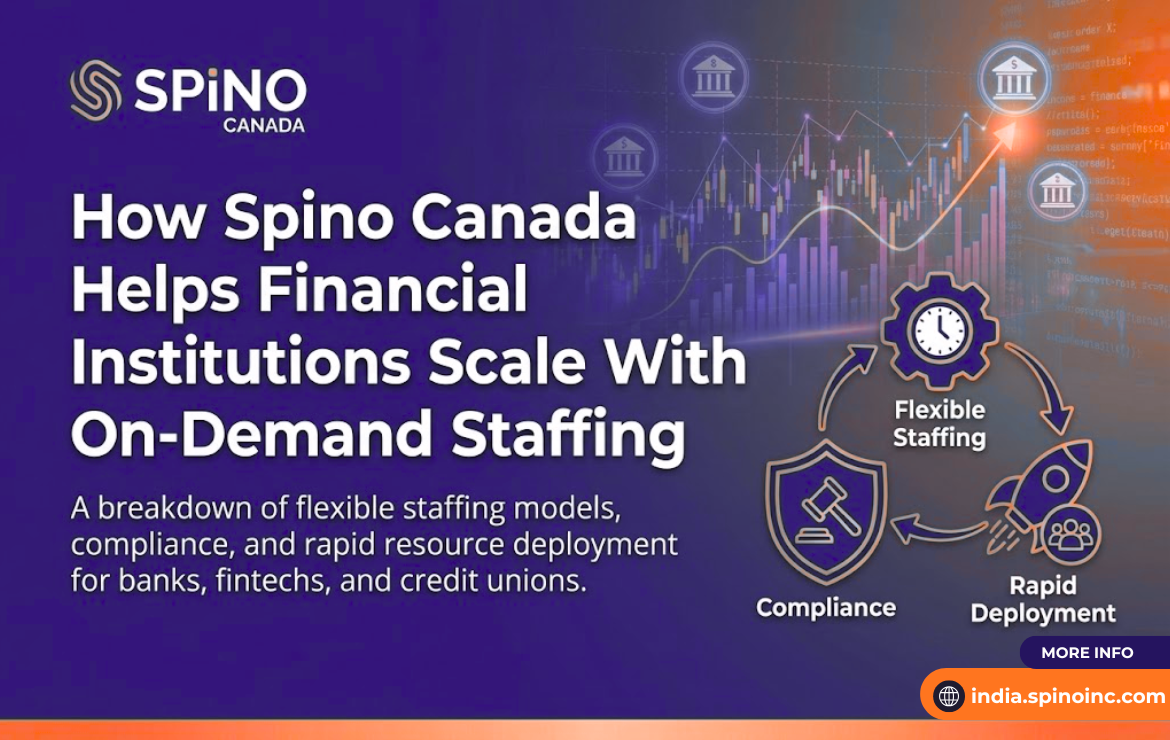
In the rapidly evolving landscape of North American finance, stability is no longer the only metric of success. Today, agility is the currency of survival.
For decades, Canadian financial institutions—from the “Big Five” banks to local credit unions—operated on rigid, hierarchical structures. Hiring was a slow, deliberate process designed for lifetime employment. However, the rise of agile fintech competitors, shifting regulatory landscapes (such as Open Banking), and the urgent demand for digital transformation have rendered traditional hiring models obsolete for project-based needs.
This is the new reality: Financial institutions need to scale their technical and operational workforce up and down instantly, without compromising security or compliance.
This guide explores how Spino Canada is reshaping the industry with on-demand staffing, providing a blueprint for financial leaders to leverage flexible talent for sustainable growth.
1. The Agility Crisis in the Financial Sector
Before understanding the solution, we must diagnose the problem. Why are Chief Technology Officers (CTOs) and HR leaders in the financial sector struggling?
The “Time-to-Hire” Gap
In the technology sector, the average time to hire a specialized developer is roughly 45 to 60 days. In the highly regulated financial sector, this can stretch to 90+ days due to background checks, multiple approval layers, and security vetting.
- The Consequence: By the time a bank hires a team to build a new mobile feature, the market opportunity may have already passed, or a competitor has already launched a superior product.
The Skills Mismatch
Legacy banking runs on mainframes (COBOL), while modern banking apps run on the cloud (AWS, Azure, Python, React). Financial institutions are in a unique bind: they need to maintain legacy systems while building modern ones. Finding talent that spans this chasm—or scaling two different types of teams simultaneously—is a massive logistical burden.
Budgetary Rigidity
Hiring full-time employees (FTEs) increases fixed costs (CapEx). When a project ends, the bank is left with a bloated payroll. In an economic downturn, this rigidity creates financial risk.
2. Enter Spino Canada: What is On-Demand Staffing?
Spino Canada represents a paradigm shift from “Recruitment” to “Resource Deployment.”
On-demand staffing is not traditional “temp agencies” sending general administrative staff. It is a sophisticated, high-level service providing specialized professionals—Software Engineers, Data Scientists, Compliance Officers, and Cyber Security Analysts—who are vetted and ready to deploy immediately.
The Spino Philosophy: “Plug-and-Play” Capability
Spino operates on the premise that financial institutions don’t just need bodies in seats; they need capabilities.
- Need to migrate to the cloud? You need Cloud Architects.
- Need to clear a backlog of KYC (Know Your Customer) checks? You need Compliance Analysts.
Spino curates a “warm bench” of talent specifically tailored for the nuances of the Canadian and North American financial markets.
3. Flexible Staffing Models: A Strategic Menu
One size does not fit all. A credit union in rural Canada has different needs than a neobank in Toronto. Spino Canada offers three distinct engagement models to ensure the right fit.
Model A: Staff Augmentation
“The Team Extension”
- Scenario: Your internal team is building a new trading platform, but you are three Python developers short, and the deadline is in two months.
- The Solution: Spino deploys three senior Python developers who integrate into your existing Agile squads. They attend your stand-ups, use your Jira tickets, and report to your Engineering Manager.
- Key Advantage: You retain full control over the project and culture, while Spino handles the sourcing, payroll, and HR administration.
Model B: Managed Teams (The “Pod” Approach)
“The Outcome-Based Solution”
- Scenario: A bank wants to launch a new loyalty rewards portal but their internal IT team is 100% utilized on maintenance. They don’t have the bandwidth to manage new hires.
- The Solution: Spino provides a self-contained “Pod.” This includes a Project Manager, a Lead Developer, two Junior Developers, and a QA Tester. The bank simply provides the requirements; the Spino Pod delivers the finished portal.
- Key Advantage: Reduces management overhead. The bank manages the product, Spino manages the people.
Model C: Project-Based / SOW (Statement of Work)
“The Specialist Strike Team”
- Scenario: A specific, finite event occurs—such as a merger, a data center migration, or a regulatory audit (e.g., FINTRAC compliance update).
- The Solution: Spino deploys a niche team of experts for a fixed period (e.g., 6 months) to execute that specific task. Once the task is done, the team disbands.
- Key Advantage: Cost predictability. The institution pays for the deliverable, mitigating the risk of scope creep.
4. The Compliance Factor: Trust is Non-Negotiable
In other industries, “move fast and break things” is a motto. In finance, “move fast and break things” leads to lawsuits and license revocation.
The biggest hesitation financial institutions have regarding outsourcing is Risk.
- Who are these external contractors?
- Do they have access to PII (Personally Identifiable Information)?
- Are they background checked?
How Spino Canada Mitigates Risk
Spino understands that in finance, compliance is the product.
- Enhanced Vetting: Every candidate undergoes a rigorous screening process that mirrors the internal standards of top-tier banks. This includes criminal record checks, credit history verification (essential for financial roles), and education verification.
- Regulatory Training: Spino consultants are not just technically skilled; they are “Regulatory Ready.” They are briefed on data privacy laws (PIPEDA, GDPR), anti-money laundering (AML) protocols, and cybersecurity best practices before they access client systems.
- NDA & IP Protection: All intellectual property created by Spino staff belongs to the client. Strict Non-Disclosure Agreements (NDAs) are enforced to protect sensitive banking data.
5. Speed as a Competitive Advantage
In the fintech era, speed is a feature.
Imagine a scenario where a new cybersecurity threat (Zero-Day vulnerability) is discovered. A bank cannot wait 3 months to hire security patches experts. They need them now.
The 48-Hour Deployment Cycle
Because Spino maintains an active network of pre-screened professionals, they drastically reduce the time-to-fill.
- Traditional Hiring: 8-12 Weeks.
- Spino Deployment: 24 to 72 Hours.
This speed allows financial institutions to react to market changes in real-time. Did the central bank change interest rates, causing a flood of mortgage refinancing inquiries? Spino can deploy a support team to handle the volume spike within days, ensuring customer service levels remain high.
6. The Economic Argument: CapEx vs. OpEx
CFOs love on-demand staffing because it optimizes the balance sheet.
Shifting to Variable Costs
Full-time employees represent a rigid fixed cost. If revenue dips, those costs remain. On-demand staff are a variable cost. You pay for them only when there is work to be done.
The “Hidden Costs” of Hiring
When a bank hires an employee for $100,000, the actual cost to the company is often closer to $140,000 when factoring in:
- Recruitment agency fees (20-25%).
- Health benefits and insurance.
- Pension/RRSP contributions.
- Paid time off and sick leave.
- Severance risks.
Spino Canada absorbs these liabilities. The hourly or monthly rate paid by the bank is all-inclusive. There are no surprise costs, no severance packages to negotiate, and no payroll tax complexities for the client.
7. Real-World Use Cases
How are Canadian institutions actually using Spino? Here are three hypothetical examples based on industry trends.
Case Study 1: The Legacy Modernization
The Challenge: A regional Credit Union needs to update its mobile app to allow remote cheque deposits. Their in-house team specializes in the core banking system but lacks React Native (mobile) experience. The Spino Solution: Spino augments the team with two Senior React Native developers for 9 months. The Outcome: The feature launches on time. The Credit Union avoids hiring full-time mobile developers they wouldn’t need after the launch.
Case Study 2: The Fintech Scale-Up
The Challenge: A Toronto-based Fintech raises Series B funding. They need to double their engineering headcount immediately to expand into the US market. Their internal HR team is overwhelmed. The Spino Solution: Spino acts as a strategic partner, deploying a “Managed Squad” of 10 developers and QA engineers to take over the development of the US-specific payment gateway. The Outcome: The Fintech scales effectively without breaking its internal culture or overwhelming its management layer.
Case Study 3: The Audit Crunch
The Challenge: A bank is facing a routine regulatory audit and realizes their documentation for a specific loan portfolio is disorganized. The Spino Solution: Spino deploys a team of 5 Junior Data Analysts and 1 Senior Compliance Officer for a 6-week “sprint” to organize, digitize, and review the files. The Outcome: The audit is passed successfully with zero disruption to the bank’s daily operations.
8. Frequently Asked Questions (FAQs)
Q1: How does on-demand staffing differ from traditional recruitment agencies? A: Traditional recruitment agencies focus on finding permanent employees, a process that can take months. Spino Canada’s on-demand staffing focuses on immediate resource deployment. We maintain a pool of pre-vetted, specialized professionals ready to join your projects within 24 to 48 hours. It is designed for agility, project-based needs, and rapid scaling rather than slow, long-term hiring.
Q2: How does Spino ensure compliance with financial regulations like PIPEDA and AML? A: Compliance is our top priority. All Spino consultants undergo rigorous background checks, including criminal and credit history verifications. Furthermore, our professionals receive specific training on Canadian financial regulations, data privacy (PIPEDA/GDPR), and Anti-Money Laundering (AML) protocols to ensure they meet the strict standards of banks and credit unions.
Q3: Can Spino Canada help with niche technical roles for Fintech? A: Absolutely. We specialize in hard-to-find technical skills. Whether you need Python developers for backend systems, React Native experts for mobile apps, Blockchain developers, or Cyber Security analysts, our talent pool is curated specifically for the modern technical needs of the financial sector.
Q4: What is the difference between Staff Augmentation and Managed Teams? A:
- Staff Augmentation: You hire individual experts (e.g., 2 developers) who join your existing team and report to your managers. You retain full control.
- Managed Teams: We provide a complete unit (Project Manager + Developers + QA) to take ownership of a specific deliverable. We manage the team and the outcome, reducing your management overhead.
Q5: Is on-demand staffing cost-effective for long-term projects? A: Yes. While hourly rates may seem higher than a permanent salary, the total cost of ownership is often lower. You save on recruitment fees (20-30%), benefits, insurance, payroll taxes, and severance costs. Plus, the flexibility to scale down immediately when a project ends prevents the financial drain of paying for idle resources.
Q6: How quickly can Spino deploy a team for a critical project? A: For most standard technical roles, we can present qualified candidates within 24 to 48 hours. Onboarding is streamlined so that resources can be active and productive within days, not weeks.
Q7: Does Spino Canada support remote work arrangements? A: Yes. We support on-site, hybrid, and fully remote work models. This allows financial institutions in Canada to access top-tier talent from across the region without being limited by their physical office location.
9. Conclusion: The Future is Flexible
The days of the static, unchanging bank workforce are over. To compete with agile disruptors, traditional institutions must adopt a hybrid workforce strategy: a strong core of permanent employees supported by a flexible, elastic layer of on-demand talent.
Spino Canada serves as the bridge to this future. By combining the speed of the gig economy with the security and compliance of the corporate world, Spino empowers financial institutions to stop worrying about headcount and start focusing on innovation.
Ready to scale your financial workforce? Don’t let talent shortages slow down your growth. Contact Spino Canada today to discuss your resource needs.
👉 Visit us at: https://canada.spinoinc.com/